Our commitment to sustainability
It is important to us, and to our customers, that we are a responsible business and do everything in our power to be a force for good. The products we sell should not only be high quality but also manufactured responsibly, using materials that are kind on the environment, and made by a work force which enjoys high employment standards.
We have examined our own operations, and our supply chain partners, to ensure we are adhering to best practices, and we’re setting ourselves high standards.
We intend Wrkhaus to be a market leader in providing sustainable products to the industry, and once our items have come to the end of their working life, we wish to pioneer recycling solutions, enabling our clients to divert their clothing waste from landfill to higher-value waste streams.
To start us on this journey, we have calculated our carbon footprint with a baseline year of 2025, across the key areas of the business.
Our targets
We are committed to achieving net zero emissions by 2050 in line with government targets. We will halve our absolute scope 1 and 2 emissions by 50% by 2035, and commit to the UN’s Race to Zero emissions reduction pledge1and report our emissions annually through the SME Climate Hub.
We expect to grow the business during this time so will focus on our emissions intensity per member of staff. This is currently 5.3 tonnes per FTE (scopes 1&2).
Our baseline carbon footprint
Our principal activities which generated emissions in the 12 months to July 2025:
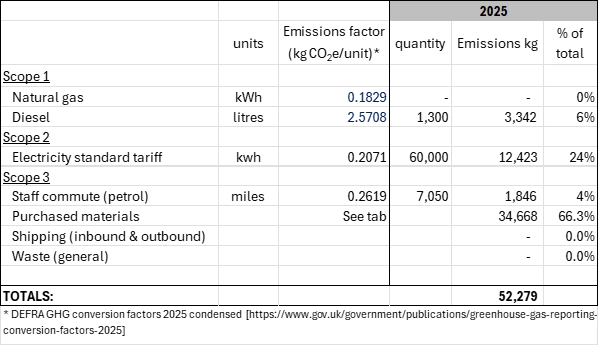
*Note this is a direct consequence of purchased electricity and is based on an average-data method, not supplier specific
The intensity of our scope 1 & 2 emissions is 5.3 tonnes per person.
The intensity of our emissions including supply chain, as so far measured, is 17.4 tonnes per person. Note that supply chain emissions have only considered the top 10 best-selling lines (which is 67% of all sales); these emissions derive from a spend-based analysis (using EXIOBASE emission factors per £) so this is only an approximation and inevitably an under-estimate of our scope 3 emissions.
We have not yet measured waste volumes nor emissions from inbound and outbound shipping.
Actions already undertaken
Supply chain:
- We have reviewed our key suppliers and best-selling lines and de-listed those with poor sustainability or workforce standards, or inadequate traceability of these aspects.
- We are working closely with a supplier who offers an environmentally friendly range, with more European manufacturing and integrated textile mills. This gives us increased confidence in the ethical production of our garments.
- Most of our top selling lines now come from a warehouse 10 miles away; previously this was in Scotland. Our inbound logistics emissions are therefore much smaller, a saving which will amplify as we scale our sales volumes.
Waste:
- Any garments that are spoiled during finishing e.g. embroidery errors, are re-used for training purposes rather than scrapped.
- We have asked our suppliers to send shipments in plain cardboard cartons so we can re-use them for outbound shipping; this has been partially successful.
Actions from 2026 onwards
Energy usage:
- We expect to move to more modern premises during 2026, with more energy efficient heating which will be more comfortable for our team to work in all year round, and also save us both money and emissions.
- We will improve the scheduling of various tasks that involve energy-hungry equipment such as the steam press, so that it is only powered up when we plan to use it, rather than for the whole working day.
- We will also conduct an energy efficiency audit of our equipment when we move: this will include circuit-level monitoring of equipment with better visibility to our team of the energy usage day by day. Encourage and incentivise our team to reduce energy usage, and communicate & celebrate any gains that we achieve.
Fuels:
- We are replacing our diesel forklift with an electric forklift and manual pallet trucks from summer 2026.
Purchased goods and services:
- We will continue to work closely with our key suppliers to ensure full traceability of goods, and communicate to our customers what the benefits are of ethical sourcing principles.
- Our key supplier is developing innovations in the materials used (e.g. alternatives to leather) which will lower our emissions in our core range.
- We will use specific emissions factors provided by our suppliers wherever possible to accurately track materials emissions, rather than relying on industry-average emissions factors as we have to date.
- Using frameworks such as the B Corp Impact Assessment2 or ISO 20400: Sustainable Procurement standards, we will identify areas within our supply chain where we could be stronger, environmentally and socially, and develop a long-term plan to continually meet high standards as we scale.
Logistics:
- Currently our goods are either collected by customers or sent using national courier networks. In future we plan to source an electric van which will be able to deliver to the majority of our customers, which are mainly within easy reach. This will reduce our emissions, and make it easier to measure them accurately.
Waste:
- We will continue to work with suppliers to reduce inbound packaging that can’t be re-used or re-purposed. We aim to eradicate all plastic from our packaging sent to customers. From March 2026 all paper packaging we buy will be from recycled sources.
- We will investigate the feasibility of a cardboard shredder so that we can re-use inbound cartons as protection for outbound goods, saving money on waste and on buying packing materials.
- We will investigate uses for the single-use plastic sheets used in our screen printing processes; currently these go in general waste.
- From June 2026 our cardboard and textile waste will be collected for recycling, rather than going into general waste.
- We will offer our clients sorting bins for end of life gloves and coveralls, and we will find productive waste streams for these materials. We are determined to reduce the amount of workwear than ends up in landfill.
Risks and Uncertainties
We anticipate that emissions from our supply chain will always be the dominant part of our footprint and currently we have only made an approximation of the emissions, based on our best-selling lines, and using spend-based analysis. As we get more accurate data from our key suppliers, this will be refined over the coming years, and may require a change to our baseline. However, for the time being it shows us where we should focus our attention in order to address emissions as we grow in sales volumes.